

Georgian qvevri wine is wine fermented in an egg-shaped clay vessel that is sealed and buried in the ground. UNESCO, which put the method on its intangible heritage list in 2013, says the juice, skins, stalks and pips go into the vessel together and ferment for five to six months before the wine is drunk (UNESCO). For a visitor the consequence lands on the tasting table: a white made this way can be amber, tannic and oxidative, and it does not taste like a white from a steel tank.
This page covers the vessel, the skins, the four grapes you will meet, the harvest window and what a day from Tbilisi to Kakheti can and cannot show you. It draws on the UNESCO record, Georgia's National Wine Agency, a 2017 paper in PNAS and the Georgian National Tourism Administration, all checked on 2026-09-30, UNESCO through an archived copy. The qvevri is a method, not a place: our UNESCO page explains why there is no listed vineyard to walk into, and the Kakheti page is where the tours live.
What is a qvevri?
The National Wine Agency calls it a unique clay vessel for making and storing wine. It says the shape that exists today dates to the third millennium BC, that earlier vessels were mostly small, 1 to 1.5 m tall, with a flat base, and that the egg shape is now the most common (National Wine Agency, qvevri wine). Sizes run from a few hundred liters to several tons. The agency says Kakheti is known for large ones, 6,000 to 8,000 liters, and that the most common capacity is 1 to 2 tons.
Making one takes an average of three months, most of it construction and drying, before firing in a special oven (same agency page). The agency also says the clay contains limestone, which reacts with tartaric acid and strengthens the walls. In Imereti, in the west, the same vessel is called a churi (National Wine Agency, winemaking regions).
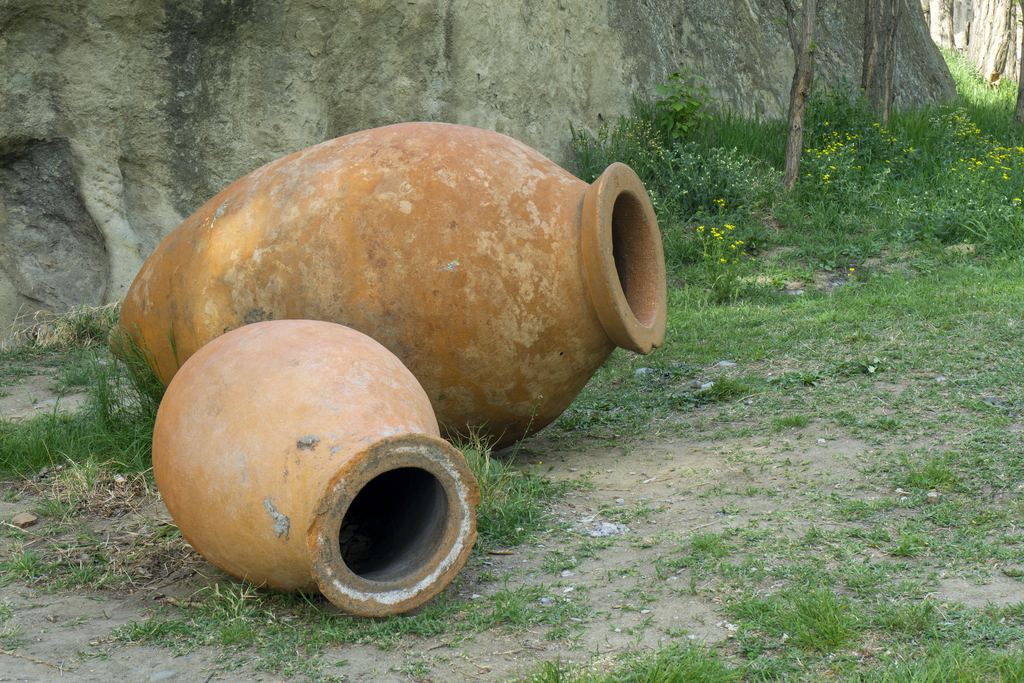
How does fermentation in a buried clay jar work?
In Kakheti the agency describes the sequence this way: grapes go through a winepress called a satsnakheli, and the must, badagi in Georgian, is poured into the qvevri with the chacha, meaning the skins, stalks and pips (National Wine Agency). The agency says the contents need frequent stirring, four to five times a day, in the period before the wine is fermented. Once fermentation ends, the chacha sinks to the bottom and the pips get covered by sediment, which separates them from the wine.
| Stage | What happens | Source |
|---|---|---|
| Pressing | Grapes pass through a winepress (satsnakheli); the must (badagi) goes into the qvevri | National Wine Agency |
| Fermenting | Must, skins, stalks and pips ferment together with frequent stirring | National Wine Agency |
| Settling | The chacha sinks to the bottom and the pips are covered by sediment | National Wine Agency |
| Sealing | The qvevri is closed, then closed hermetically after malolactic fermentation | National Wine Agency |
| First racking | Takes place in March | National Wine Agency |
| Ageing | The wine ages for about a year, with regular checks | National Wine Agency |
| Whole process | Fermentation in the buried, sealed vessel lasts five to six months before drinking | UNESCO |
Temperature does the work that a factory does with equipment. The agency says a buried qvevri keeps a constant 13 to 15 degrees Celsius, the range it gives for fermentation, and that Kakheti buries its vessels in the cellar while western Georgia stores hermetically sealed qvevris in the open air (National Wine Agency). "Buried" is the Kakheti picture, not the whole country. UNESCO's summary says the vessel is buried, and for the eastern wine you will taste on a tour from Tbilisi that is the relevant case.
Why is qvevri white wine amber?
Because the skins stay in. The agency calls keeping the wine on its chacha, both during and after alcoholic fermentation, the first and foremost rule of qvevri winemaking. For reds it says contact usually lasts only through fermentation, 7 to 10 days and at most 2 weeks. For white grapes the wine stays on the chacha until spring. A wine left that long, it says, turns dark straw, golden or tea-colored, stays clear, shows fruit tones, has a moderate amount of tannin and is naturally stable (National Wine Agency).
The grape changes the result. The agency says qvevri Rkatsiteli is typically more powerful and moderately tannic with crisp acidity, with honey, dried orange peel, spices and apricot. Its Kisi page uses the word amber and lists apricot, mango, lime, orange and walnut (National Wine Agency, white varieties). The agency does not define "amber", so read it as the color a long stay on the skins gives, not as a category with rules.
A red on the skins for a week or two and a white on the skins until spring are different wines made in the same kind of jar. "Qvevri" on a menu tells you the vessel. It does not tell you how long the skins stayed in.
Kakheti method, Imereti method, European style
The agency separates three ways of handling the same raw material. The table puts them side by side.
| Style | How it is made | What the agency says about the wine |
|---|---|---|
| Kakheti qvevri | All of the chacha goes into the qvevri; white wine stays with it until spring | Dark straw, golden or tea color; moderate tannin; Rkatsiteli shows honey, dried orange peel, spices, apricot |
| Imereti qvevri (churi) | At most one third of the chacha is added; the wine stays about two months, then the pulp is removed and the wine moves to barrels | Beautiful yellow color, full, quite harmonious and cheerful |
| European style | The grapes are vinified the European way; the agency gives Tsinandali as a classic Kakheti example | Rkatsiteli shows subtle floral aromas with citrus, quince and apple |
The last row matters for a tour. The agency says Kakheti grapes can make both kinds, and that Saperavi is made in qvevri and in European style. A tasting room that pours only one of them shows half the region.
Which grapes will you taste: Rkatsiteli, Mtsvane, Kisi, Saperavi?
Four names cover most of what a Kakheti cellar pours. The Georgian National Tourism Administration lists Kakhuri Mtsvane, Saperavi, Rkatsiteli and Khikhvi as the most popular varieties of the region (georgia.travel, Kakheti). The table keeps to what the agency's own variety pages say.
| Grape | Color | What the agency says | When it ripens in Kakheti |
|---|---|---|---|
| Rkatsiteli | White | Leading white grape in Georgia, native to Kakheti; quiet aromatics, often blended with 15 to 20 percent Mtsvane Kakhuri for Gurjaani, Tsinandali and Vazisubani; made in qvevri and European style | Early October, after Mtsvane Kakhuri |
| Mtsvane Kakhuri | White | Means green Kakheti; one of six Mtsvane types; shows more apricot and stone fruit in qvevri; solo grape of the Manavi PDO | Last two weeks of September, before Rkatsiteli |
| Kisi | White | Indigenous to Kakheti; it almost disappeared by 2000 after the Soviet preference for Rkatsiteli; amber qvevri wines show apricot, mango, lime, orange, walnut | Last two weeks of September, before Rkatsiteli |
| Saperavi | Red | Georgia's leading red grape; inky, often fully opaque, sappy and tannic; made in qvevri and European style | Not given on the page we read |
Sources for the table: the agency's white and red variety pages. Kisi is the detail worth remembering. The agency says it became almost extinct by 2000 and that some 50 to 60 year old vines still stand in the Telavi district, with more being planted. A Kisi on a tasting list is a variety that nearly did not make it, and it is also the one the agency describes as amber.

Is Georgian wine the oldest in the world?
The claim has a paper behind it, and the paper says less than the brochures. McGovern and colleagues analyzed pottery from two early Neolithic villages, Shulaveris Gora and Gadachrili Gora, in Kvemo Kartli, within 2 km of one another and roughly 50 km south of Tbilisi. They report "the earliest biomolecular archaeological evidence for grape wine and viniculture from the Near East", dated to about 6,000 to 5,800 BC (PNAS, 2017). Read that as the oldest evidence found so far, for that region and with that method. It is not a statement about who made the first wine.
The paper is also cautious about the vessel. It says "no evidence has yet been found" of how the Shulaveri and Gadachrili jars were positioned, or whether they were partly or fully buried. It dates the earliest archaeological evidence for qvevri winemaking in Georgia to the Iron Age, the eighth to seventh centuries BC. The tourism administration's wine page goes further: it says that 8,000 years ago Georgians "already used" the qvevri, that the people of Neolithic Georgia "were the very first in the world to produce wine", and that the qvevri is on UNESCO's world heritage list (georgia.travel, Georgian wine). UNESCO's own record is the Representative List of the Intangible Cultural Heritage of Humanity. A guide who repeats the brochure line is not repeating the paper.
More dated curiosities, including the ones we could not confirm, are in wine facts worth checking.
When is the harvest in Kakheti?
The Georgian word is rtveli. The agency's Georgian-language harvest pages use it for the harvest, and the agency keeps one page per year (National Wine Agency, harvest). It gives no calendar dates for a typical year. What it does give is ripening by variety, in the table above: Kisi and Mtsvane Kakhuri in the last two weeks of September, Rkatsiteli in early October. Those are ripening windows, not picking dates, and they move from year to year.
For the Black Sea coast the agency is different. It says vintage there started very late, in November and sometimes until the end of January, on a coast it describes as subtropical and humid. A harvest trip to Kakheti and one to the coast are not the same trip.
We found no official statement on whether family cellars take visitors during the pick. If you are booking for late September or early October, ask the operator or the cellar first. Do not assume a tasting is on offer while the grapes are coming in.

What do you see in a Georgian wine cellar?
UNESCO's summary says knowledge of making qvevris and wine passes down in families, neighbors and friends, and that they join in communal harvesting. It adds that wine cellars are still considered the holiest place in the family home (UNESCO). The agency says Kakheti qvevris are buried in the cellar. Put together, what a visitor most often sees is a floor with round openings and lids, not a hall of vessels standing up. That last step is our reading of the two sources, not a statement from either.
The tourism administration says you will see road signs marked "Wine Route" in nearly every region, and that they lead either to a large industrial winemaker or to a small family cellar with its own local food (georgia.travel). The difference matters. A big producer and a family cellar can both pour qvevri wine, but only one of them is likely to let you look into a vessel.
Questions that are worth asking at the door:
- Is this wine made in qvevri, in steel or in oak, and is the one in my glass the qvevri one?
- How long did the skins stay in?
- Are the vessels buried here, and can I see one open?
- Are any of the other wines on the tasting made in the European style?
For the wider set of words you will hear, see the wine tour glossary.
How do you get from Tbilisi to Kakheti?
The Georgian National Tourism Administration's Kakheti page gives the road time from Tbilisi as 1:50 hours (georgia.travel, Kakheti). It does not say to which town in the region, and Kakheti is large. Doubling the figure gives nearly four hours on the road in a day, which is our arithmetic on the official number. That leaves a day trip room for a small number of stops.

The same site has a regional transport search and a page on rental and custom transport, but the results load in a form we could not read, so we describe no bus, minibus or train and no timetable. Check the operator's current information.
If you rent a car, read the drink-driving page first. The row for Georgia is there, with the article of the law we read and its date, and we do not repeat the figure here. Zero is the safest number. Tour or rental car compares the options by region, and how to choose a wine tour covers private and group formats.
Will you like qvevri wine, and will one cellar be enough?
This is our judgment, not a survey: the style divides people. The agency's own words are the reason. A white kept on its skins for months is tannic and oxidative, with flavors of dried orange peel and walnut instead of citrus and green apple. If you like a clean, cold, fruity white, the amber one may taste like a different drink.
A day tour from Tbilisi may include only one cellar, and the listing will not always say what that cellar pours. A single stop can show you one style and leave out the other. Before you book, read the listing for the number of cellars and the wines included, and ask whether the tasting covers a qvevri wine and a European-style one from the same grape. The page on reading a tour listing explains what "tastings" can mean.
If you already know you dislike tannin in a white, say so at the first cellar. The agency says the same Kakheti grapes are made both ways, so a European-style bottle exists to be asked for.
Georgian qvevri wine: questions readers ask
What is qvevri wine?
Wine fermented in an egg-shaped clay vessel that is sealed and buried. UNESCO says the juice, skins, stalks and pips ferment there for five to six months before the wine is drunk (UNESCO). The method was inscribed in 2013.
Is qvevri wine the same as amber wine?
Not always. Amber is the color a white gets from long contact with its skins. The agency says reds in qvevri usually stay on the skins for 7 to 10 days and at most 2 weeks, while whites stay until spring (National Wine Agency).
Which grapes are used for qvevri wine in Kakheti?
The agency describes qvevri wines from Rkatsiteli, Mtsvane Kakhuri, Kisi and Saperavi, and says each is also made in European style (National Wine Agency). See the table above.
When is the harvest in Kakheti?
We found no official calendar dates. The agency says Kisi and Mtsvane Kakhuri ripen in the last two weeks of September and Rkatsiteli in early October (National Wine Agency). Dates move every year.
Is qvevri wine the oldest wine in the world?
The oldest evidence found so far is pottery residue from Georgia dated to about 6,000-5,800 BC. The paper found no evidence of whether those jars were buried, and dates the earliest evidence of qvevri winemaking to the eighth to seventh centuries BC (PNAS, 2017).
Can you visit a qvevri cellar as a day trip from Tbilisi?
The tourism administration gives 1:50 hours by road from Tbilisi to Kakheti. We could not read an official timetable for public transport. See Kakheti and how to read a tour listing.
Sources and method
On 2026-09-30 we downloaded each page below as raw text and searched it for the figures and the quoted phrases used here, instead of relying on a summary. UNESCO's page blocks automated requests, so we read an Internet Archive copy of it, a capture from 2022. The agency's pages give hectare counts dated 2004 and 2014; we left them out because they age. We did not find an official page that defines the word marani, so the page says cellar. We confirmed no public transport from Tbilisi, no Saperavi ripening window and no harvest dates. Sources:
- UNESCO intangible heritage: Ancient Georgian traditional Qvevri wine-making method
- National Wine Agency of Georgia: Qvevri wine
- National Wine Agency: viticulture and winemaking regions
- National Wine Agency: white grape varieties and red grape varieties
- National Wine Agency: harvest
- McGovern et al., Early Neolithic wine of Georgia in the South Caucasus, PNAS 2017 (DOI 10.1073/pnas.1714728114)
- Georgian National Tourism Administration: Kakheti
- Georgian National Tourism Administration: Georgian wine, an 8000 year old tradition
- Our drink-driving page, for the Georgian legal text
Data verified on. Facts checked on the pages listed above on this date. UNESCO's page was read as an Internet Archive copy from 2022. Editorial Policy
Wine Tours Editorial earns a commission when you book through links on this page. It does not change the price you pay. See our editorial policy.
Compare Kakheti tours from Tbilisi
Open the Kakheti page to see what the tours cover before you pick a day.