
The earliest chemical evidence of wine found so far comes from clay jar fragments in two Neolithic villages about 50 km south of Tbilisi, dated to roughly 6,000 to 5,800 BC. The team that published it in PNAS in 2017 wrote "earliest", not "first": the earliest biomolecular archaeological evidence for grape wine and viniculture from the Near East. That one word separates a wine fact from a wine legend.
This page keeps the facts. We opened each source on 2026-09-30 and searched its text for the number or phrase we use, so every fact below names its source in the same sentence. Where a fact has a place you can visit, we say where, and what to ask when you get there. The uncomfortable part comes later: several stories that guides repeat are older than the evidence for them, and the Chianti consortium, which uses the best-known one as its trademark, tells it as a legend on its own website. For the vocabulary, see the wine tour glossary.
Which wine facts can you check on a visit?
Seven places, each with something a guide can show you and a question that tests what you are told.
Georgia: what happens inside a buried qvevri
UNESCO's entry for the qvevri wine-making method (inscribed 2013) says the juice, skins, stalks and pips are poured into a qvevri that is sealed and buried, and the wine ferments there for five to six months. The vessel is egg-shaped earthenware. Georgia's National Wine Agency adds the numbers: the most common capacity is one to two tons, and Kakheti has vessels of six to eight thousand liters. It also draws a line inside the country. In Kakheti all the skins go into the fermentation; the Imereti way adds a maximum of one third. Red wine usually stays on the skins for the length of fermentation, seven to ten days and at most two weeks, while white stays on them until spring.
In Kakheti the vessels are buried in the cellar. In western Georgia, the agency says, the wine is kept in sealed qvevri in the open air. The question to ask at a marani: how long did this wine stay on its skins? The answer tells you which of the two methods you are drinking. More in our qvevri guide and on the Kakheti page.
Champagne: cellars that were quarries first
UNESCO's decision on Champagne Hillsides, Houses and Cellars says bottle fermentation "required a vast network of cellars". In Reims, it says, the former Gallo-Roman and medieval chalk quarries were reused, while cellars in Épernay or on the hillsides were dug for the purpose. So two cellars on the same tour can have different origins. Ask which one you are standing in.
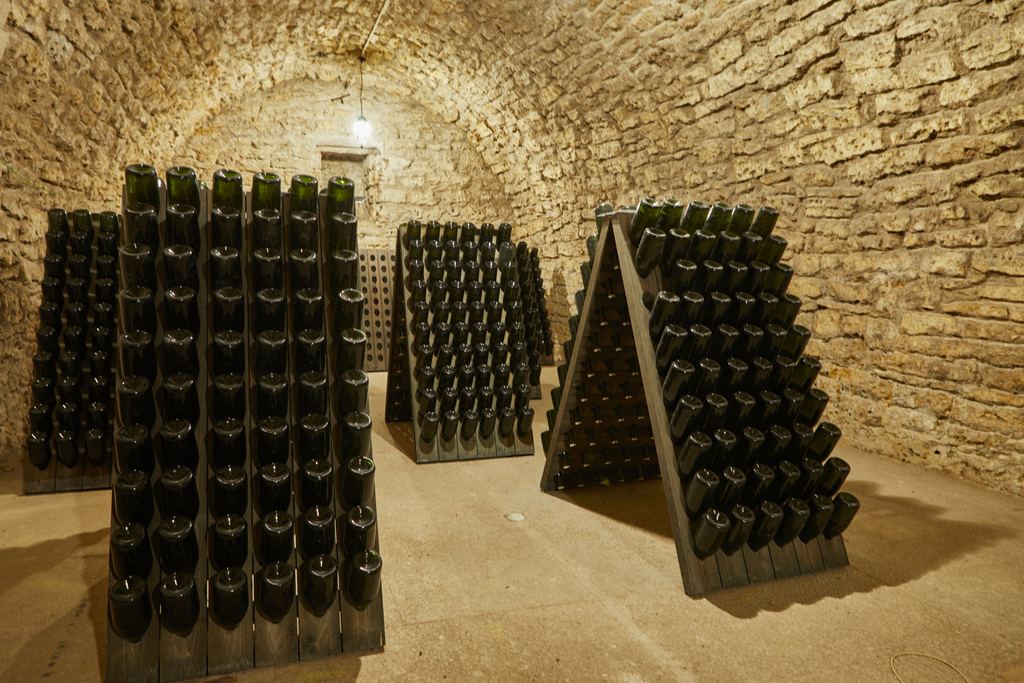
The Comité Champagne's history dates much of what a cellar talk describes. Cork stoppers reached Champagne in 1685 and a thicker bottle followed in 1770. In 1837 a Châlons pharmacist, Jean-Baptiste François, worked out how to measure the sugar that makes the bubbles. Riddling racks, the pupitres, were invented at the turn of the 19th century, and in 1884 Armand Walfard developed cold disgorging, which freezes the sediment plug in the neck at around -27°C. The Comité says that method is still used. The words are in the glossary; for where to base yourself, see Reims or Épernay and the Champagne page.
Douro: two kinds of terrace from two eras
UNESCO's text on the Alto Douro Wine Region separates the terraces by age. The older ones, the socalcos, date from before phylloxera (pre-1860): narrow, irregular, held by schist walls, with room for one or two rows of vines. The long, regular, continuous terraces date from the end of the 19th century and the start of the 20th, when the vineyards were rebuilt after the phylloxera attack, and they are wider and slightly sloping so the vines catch more sun. UNESCO also says Port is a wine "of a quality defined and regulated since 1756". Ask the guide, or the estate, which terraces are which.
The wine institute, the IVDP, describes Port as a fortified wine: fermentation is stopped by adding grape brandy, and the alcohol is usually between 19 and 22% by volume. That is well above a table wine, one more reason the driver should skip it. The institute's site also describes the Douro Museum in Peso da Régua, which it calls a museum of the Douro territory and also a wine museum. See the Douro Valley page.
Jerez: a guild code from 1483 and a raid on Cádiz
The sherry regulatory council's history page says the town council issued regulations for the guild of raisin and grape harvesters on 12 August 1483, covering the harvest, the casks, the ageing system and trade. In 1587, it says, Sir Francis Drake attacked Cádiz and carried off 3,000 kegs of sherry. The solera and criadera system, on its account, took its distinct shape in the late 18th century, which is a good date to ask about if a bodega tour says the solera goes back "centuries". The council also says the first Spanish wine law (1933) referred to the Jerez denomination and its regulatory council, "the first to be legally constituted in Spain", and that phylloxera reached the sherry region in 1894.

We have no Jerez page: sherry is outside the destinations this site covers.
Cape Winelands: a governor's dated entry
South Africa's wine body, WOSA, says Jan van Riebeeck, the Cape's first governor, planted a vineyard in 1655 and that on 2 February 1659 the first wine was made from Cape grapes. Simon van der Stel, who took over in 1679, planted a vineyard on his farm Constantia, and WOSA says the industry began to flourish after French Huguenots settled at the Cape between 1680 and 1690. Ask an estate which of these dates it counts from. Start from the Cape Winelands page.
Pantelleria: vines planted in a hollow
UNESCO's entry for vite ad alberello (2014) says the ground is levelled and a hollow dug for each vine, the main stem is pruned to six branches in a radial bush, and the grapes are picked by hand in a ritual event that starts at the end of July. About 5,000 inhabitants own a plot. If a tour takes you there in summer, ask when the picking starts that year. The island is covered on the Sicily page.
Chianti: the black rooster is painted on a ceiling in Florence
The Chianti Classico consortium's page on the black rooster says it is the historic symbol of the old Military League of Chianti and was reproduced by Giorgio Vasari on the ceiling of the Salone dei Cinquecento in Palazzo Vecchio, Florence's city hall. The consortium's history adds two dates. In 1716 Grand Duke Cosimo III set the boundaries of the production zone between Florence and Siena and set up a group to watch for fraud, at a time when fake Chianti was being made for export, especially to England. On 14 May 1924, 33 growers founded the consortium in Radda, which the consortium calls the first producers' consortium in Italy.

The Chianti pages: Chianti and Chianti from Florence.
What happened at the Judgment of Paris?
TIME reported it in its 7 June 1976 issue under the headline "Judgment of Paris". A tasting organized in Paris by Steven Spurrier, an Englishman who ran a wine shop and a wine school there, put four white Burgundies against six California Chardonnays and four Bordeaux reds against six California Cabernets. TIME says nine French judges took part, and that they "swirled, sniffed, sipped and spat". Its report puts the result in one line: "California defeated all Gaul."
The ballots are more mixed than that line. The top red was a California Cabernet from Stag's Leap Wine Cellars, followed by three Bordeaux: Mouton-Rothschild, Haut-Brion and Montrose, all from the 1970 vintage. Among the whites the order was Château Montelena from Napa, then a French Meursault-Charmes, then two more Californians. One tasting, twenty wines, nine judges. It was a single tasting, and TIME's own ballot shows it did not prove that every California wine beats every French one. The Napa side of the story is on the Napa and Sonoma page.
When did phylloxera reach Europe's vineyards?
The Comité Champagne says phylloxera reached Europe's shores in 1863 and that virtually the whole area under vine in Champagne was decimated. In 1898 growers and the main houses founded the Champagne Viticultural Association, which replanted by grafting the local vines onto American rootstock. The sherry council puts the arrival of phylloxera in its region in 1894. In the Douro, UNESCO says the regular terraces you see today come from the rebuilding that followed. One insect, three regions, three dates, and a change you can still see in the hills.
Which dated wine facts hold up?
Twelve dated entries, each from a source named above or in the list at the end. The Georgian entry is placed first for ordering only; its label gives the real date.
Dated wine facts, from the source that dates them
Each date is the source's own. "Earliest found" means earliest so far.
The origins
c. 6000 to 5800 BC
Earliest chemical trace of wine found so far
Residues in jar fragments from two villages south of Tbilisi, Georgia (PNAS, 2017).
1483
Jerez harvesters' guild regulations
The sherry council calls them the first rules of its denomination.
1659
First wine from Cape grapes
Dated to 2 February by WOSA, four years after the first vineyard was planted.
The growth
1716
Chianti boundaries set
Cosimo III fixes the production zone between Florence and Siena.
1737
Tokaj made a closed wine region
Decree of Charles VI, described by UNESCO as among the first in the world.
1756
Port quality defined and regulated
UNESCO's date for the Douro's regulation.
1855
Bordeaux brokers rank the chateaux
Ranked by reputation and recent market prices for the Paris Universal Exhibition.
1863
Phylloxera reaches Europe
Per the Comité Champagne; it reaches the sherry region in 1894.
Today
1924
Chianti consortium founded in Radda
Thirty-three growers choose the black rooster as their symbol.
1976
Judgment of Paris
Nine French judges, twenty wines, reported by TIME on 7 June.
1991
Rioja gets its qualified designation
Rioja's regulating council lists it as the first in Spain.
2013
Qvevri winemaking inscribed by UNESCO
A method on the intangible heritage list, practised across Georgia.
Which wine legends are not true, or cannot be shown?
Six stories. For each we say where it comes from and what the source we opened does and does not support.
Dom Pérignon and the stars
The line "Come quickly, I am tasting the stars!" is attributed to the monk as he tasted the first sparkling wine. The historian Rod Phillips, in A Short History of Wine (2000), traces its first appearance to a print advertisement in the late 19th century. We read that claim in Wikipedia's article on the monk, not in the book, so treat the advertisement as reported and not confirmed by us. What we did confirm is narrower and more useful. The Comité Champagne credits Dom Pierre Pérignon, a Benedictine monk at Hautvillers Abbey, with being "one of the first" to see that different wines and crus could complement each other, and so with blending more carefully. It says that until the years 1670 to 1720 bubbles "depended very much on external conditions". It does not say he invented champagne, and we did not find the quotation in the Comité's history.
The rooster that won Chianti for Florence
The consortium tells the story itself, and calls it a legend. Florence and Siena fought over Chianti, so two knights were to ride out from their cities at the first crow of a rooster and the border would be where they met. Siena chose a white rooster, Florence a black one, which it kept shut in a dark coop, practically unfed, until it crowed long before dawn. The Florentine left early, the Sienese knight rode only twelve kilometers, and they met at Fonterutoli. The consortium's page cites no document for it. What the consortium does document is the emblem of the Military League, the 1716 boundary and the 1924 founding above.
Which region was demarcated first?
Four bodies, four dates, and each source uses the word differently. The sherry council calls its 1483 guild rules "the first rules governing our Denomination of Origin". The Chianti Classico consortium says that in 1716 "for the first time, the link between wine and territory is formalised and legally recognised". UNESCO's text on Tokaj says the legal base of its delimitation is "among the first in the world" and dates to a 1737 decree of Charles VI establishing a closed wine region (UNESCO, Tokaj). UNESCO says Port has been "defined and regulated since 1756" and does not call it the first. A regulation, a boundary decree, a closed region and a guild code are different things, and none of the sources we opened settles which counts. Be wary of any brochure that does.
Ricasoli's recipe with percentages
The consortium prints a passage from an 1872 letter by Baron Bettino Ricasoli. In it Sangiovese gives the main dose of aroma and a certain vigor, canaiolo adds sweetness that softens the hard quality of the first, and malvasia, which he says could be left out for wines meant for ageing, lightens the wine and makes it more suitable for daily use. The consortium calls this the first "recipe" for Chianti. The passage it quotes has no percentages, so if you see a formula with figures attributed to that letter, ask for the page.
The 1855 classification ranks Bordeaux's best wines today
Bordeaux's wine council says that for the 1855 Paris Universal Exhibition Napoleon III asked the region's brokers for a clear classification of its finest wines, and set the criteria himself: the reputation of each estate and the market prices of its recent vintages. The brokers' syndicate produced it, and it was established on 18 April 1855 (Bordeaux.com). It ranked estates by reputation and price in 1855, which is not the same as ranking them by taste today. Read it as a history of the trade, and check the Bordeaux page for what to visit.
Georgia made the first wine, or Persia did
Two wine bodies, two birthplaces. WOSA's history page says it is "generally accepted that wine was made for the first time in Persia", with evidence as far back as 6000 BC (WOSA). Georgia's National Wine Agency says "Qvevri wine-making started 8 thousand years ago in Georgia". The PNAS paper says neither: it reports the earliest evidence it found, at about 6,000 to 5,800 BC, backed by grape pollen, starch and skin remains found with a jar of similar type and date. That is a record of what has been dug up. Another excavation can overtake it.
What can you ask in a cellar to test a story?
Four questions, each tied to a source above. Where is that story from? A guide who says "legend" has told you something true. Was this cellar a quarry or dug for the purpose? (Champagne, UNESCO.) How long did the wine stay on its skins? (Georgia, National Wine Agency.) Which date does "traditional" count from? (The solera answer above is the late 18th century, not antiquity.)
If you are driving after a tasting, zero is the safest number. See the page on drinking and driving.
A tour listing that promises "the oldest" or "the first" of anything should give its source. Our page on reading a tour listing covers what else to check before you book.
Wine facts: questions readers ask
Is Georgian wine the oldest in the world?
It has the earliest chemical evidence found so far, at about 6,000 to 5,800 BC, according to a 2017 PNAS paper that says "earliest", not "first". A new dig could change the record. See the qvevri guide.
Did Dom Pérignon invent champagne?
Not according to the Comité Champagne. It credits him with careful blending and says the region's sparkling wines became a deliberate choice between 1670 and 1720. We did not find the "tasting the stars" line in the Comité's history.
Is the Chianti black rooster story true?
The consortium tells it as a legend. The rooster is a real emblem of the old Military League of Chianti, painted by Vasari in Florence's Palazzo Vecchio. See Chianti.
Which of these facts are on UNESCO's lists?
Champagne, the Alto Douro, Tokaj, qvevri winemaking and the vines of Pantelleria. Our UNESCO wine regions page says what each listing covers and what it leaves out.
Where can I find more answers?
The wine tour FAQ covers booking, tasting and driving, and the glossary covers the words on labels and tour listings.
Sources and method
On 2026-09-30 we downloaded each page below as raw text and searched it for the figure or phrase we quote. UNESCO's heritage pages refuse automated requests, and the WOSA addresses we cite no longer answer, so for the Douro, Tokaj, qvevri, Pantelleria and Cape entries we read the Internet Archive's copies, which may predate a change. The PNAS paper we read in its Europe PMC copy. TIME's 1976 article we read in its archive page. We relied on Wikipedia only to find the published claim about the Dom Pérignon advertisement, and say so above. We left out the Areni-1 cave, the Carmona urn, the Speyer bottle, the origin of the 750 ml bottle and the Lamego abbot story of Port, because we could not open a primary source for them today. We give no prices and no auction results.
- McGovern et al., Early Neolithic wine of Georgia, PNAS 2017 (full text via Europe PMC)
- UNESCO intangible heritage: qvevri and Pantelleria
- UNESCO decision on Champagne, Alto Douro and Tokaj
- Georgian National Wine Agency: qvevri wine
- Comité Champagne: history of Champagne
- Consorzio Vino Chianti Classico: history and the legend of the black rooster
- Sherry regulatory council: history
- WOSA: three centuries of Cape wine and back to the beginning
- IVDP: Port wines and the Douro Museum
- Bordeaux.com: the 1855 classification
- Rioja regulating council: history of the designation
- TIME, Judgment of Paris, 7 June 1976
Data verified on. Each fact checked on the source named in its sentence on this date; some UNESCO and WOSA pages read as archived copies. Editorial Policy
Wine Tours Editorial earns a commission when you book through links on this page. It does not change the price you pay. See our editorial policy.
Test the stories on the spot
Start in Kakheti, where the qvevri method on UNESCO's list is practised.