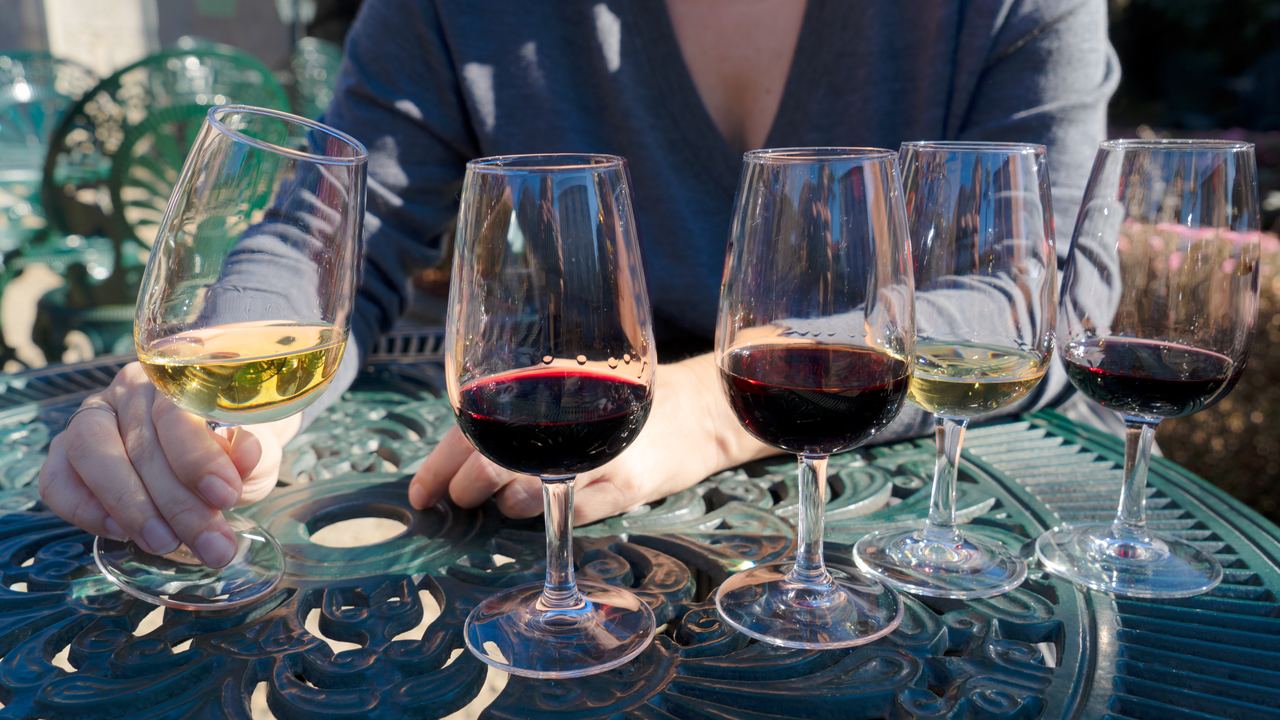
Three wineries is a full day of tasting, and four is the ceiling unless the stops are short. The Franschhoek Wine Tram's own beginner's guide recommends 3 to 4 wine estates in a day (Franschhoek Wine Tram). The Napa tourism board says a traditional tasting pour "isn't a full glass of wine" and asks you to multiply that across five wines and three tasting rooms (Visit Napa Valley). The number of stops is the easy part. The number of pours decides how the evening goes.
This is the plan for that day, written for someone who wants to remember it. It is not medical advice and it does not tell you how much to drink. If you are driving, read drink-driving limits first: zero is the safest number.
How many wineries can you visit in a day?
Three, with a sit-down lunch between the second and third. Four works when the stops are short, the cellars are close, and someone else is driving. Five is a list, not a day. By the fourth cellar you are tasting the route, not the wine, and we would drop the fifth stop every time.
| Stops | Works when | Breaks when | Our call |
|---|---|---|---|
| Three | Lunch is a real meal and each visit is about an hour | The drives between cellars are long | The default |
| Four | Visits are short, cellars are close and you are not driving | One visit runs long or lunch slips | Only with a written plan |
| Five or more | The cellars share a street or a car park | Almost anything goes wrong | Skip |
Pick the number of stops last. Decide first how many pours you will actually swallow, then fit the wineries around that number.
What does a day of tasting add up to?
A standard drink of wine in the United States is 5 ounces at 12% alcohol by volume, about 14 grams of pure alcohol (NIAAA; the CDC gives the same 5 ounces at 12%, and NIAAA Rethinking Drinking gives the 14 grams). NIAAA adds that these amounts "may not reflect customary serving sizes". A tasting pour is smaller than a restaurant glass, but we could not confirm an official pour size for tasting rooms, so the table below is arithmetic and not a measurement. Change the pour and the answer changes with it.
| Size of each pour | Total poured | Standard drinks if you swallow everything |
|---|---|---|
| 1 fl oz | 20 fl oz | 4 |
| 2 fl oz | 40 fl oz | 8 |
| 3 fl oz | 60 fl oz | 12 |
That is the uncomfortable part of a full day. If you swallow every pour, four wineries add up to several standard drinks even when the pours are small, and wines stronger than 12% count for more. The CDC says any alcohol impairs the ability to drive safely, and that impairment begins at lower blood alcohol levels than the legal limit.
So there are three ways to change the sum, and none of them involves a tougher constitution: fewer pours per stop, smaller pours, and spitting. Asking the person pouring for a smaller taste is a normal request. A pour you leave in the glass is not wasted; it is the one you did not need.

What does the day look like hour by hour?
This is our sketch, not anyone's opening hours. Times shift with the season, the region and each cellar's own schedule, so use it for the order of things and check each stop for its own hours.
Before you leave, around 9 a.m.
Eat a real breakfast, fill a water bottle and settle the transport before the first glass: who drives, or which driver, train or tour you booked. The Napa tourism board puts it in the same order and tells visitors to arrange alternate transportation ahead of time (Visit Napa Valley). It also says that in Napa you should assume a reservation is most likely required, so the first stop is booked too. Our page on when you need to book covers the rest. Decide now, not at the third cellar, who is not drinking.
First cellar, 10 a.m. to about 11:15
This is the stop for the wine you came for, because it is the one you will remember. Decide about spitting before the first pour, not at the fourth. Ask how many wines the tasting includes; the listing or the booking confirmation should say. What goes wrong here is simple. You ask for every wine on the list and then find the list runs to eight.
Second cellar, around noon
Keep it short and light. Ask what the tasting includes before you commit, because some cellars pour a flight and others pour a single wine with a tour. This is also the stop where people start buying bottles they then have to carry. Decide on one bottle, or ask the cellar whether it ships.
Lunch, about 1 p.m.
Sit down and eat a meal. A cheese board is a snack. The Franschhoek Wine Tram notes that the estates' restaurants and picnic spots fill up fast and should be reserved in advance (Franschhoek Wine Tram), and the same habit pays off anywhere. Give lunch an hour and a half. A table booked for 1 p.m. that turns into a slow two hours is the most common way the third cellar disappears.

Third cellar, around 3 p.m.
Afternoon is where the rules you set in the morning get tested. If you have been swallowing, this is the stop to spit or to ask for a single pour. If the tasting is in a cave, bring a layer: the Napa tourism board warns that some tastings and tours take place in chillier wine caves (Visit Napa Valley). Our packing page covers shoes and layers.
Fourth cellar, optional, around 4:30 p.m.
Only if the third ran short, the drive is under fifteen minutes and you are not the one driving. Check the closing time of the last stop before you leave lunch. A fourth stop that turns out to be closed is a detour, not a stop.
Getting back, about 6 p.m.
The last hour is the transport you arranged at 9 a.m. If it is a tour or a driver, this is where it earns its cost. If it is a train, find the last departure before you enter the first cellar, not after dinner. If it is you at the wheel, go back to drink-driving limits and then to the tour or rental car page.
Should you spit, and how do you do it politely?
We found no official source on spitting etiquette from the tourism boards and wine bodies we opened, the Napa tourism board's first-timer's guide included, so this section is our advice and nothing more. Spit when a later stop, a drive or a dinner is still ahead of you, and when a wine is not one you want to finish. Ask the person pouring where to empty the glass; if there is no bucket, ask for a cup.
Technique takes one minute to learn. Take a small mouthful, let it cover your tongue, lean slightly forward and let it out in one low stream. Keep your lips close together and stay clear of the splash. Practice once with water at the sink, because the first real attempt is never the one you want an audience for.
Spit by default. Swallow only the one pour you came for, and only when someone else is driving.
What should you eat and drink between tastings?
Eat breakfast and a proper lunch, and drink water because you are thirsty and because it resets your mouth between wines. Food and water make the day more comfortable. They do not make it safe to drive: the CDC says that any alcohol impairs the ability to drive safely. Nobody's snack changes that sentence.

How do you behave at the tasting bar?
Dress for the day, not the room. The Napa tourism board tells visitors not to stress about what to wear and says jeans are acceptable (Visit Napa Valley).
Tipping varies by country, and we opened one official source. Visit Napa Valley says tipping isn't required but is a nice touch for your wine educator after a great experience. We give no amounts. Outside Napa, check the local tourism site before you go.
Two habits we would keep, both our advice and not rules we could source: skip strong perfume, because it fights with the smell of the wine in your glass, and ask questions. The person pouring usually knows the vineyard, and a question about the soil gets you a better stop than a nod.
When does a full day of tasting not make sense?
When you are driving. Then the plan is one or two wines with a spit bucket, or none at all, and the limits differ by place, so read drink-driving limits for where you are. When you do not drink: a day built around pours is a long day for you, and the page for non-drinkers explains how to tell a tasting tour from a landscape tour. When you have several days: two stops a day over three days beats four in one, because you taste more wine and remember more of it.
And when you chose the region for one cellar. Then book that cellar directly and build nothing around it; how to choose a wine tour explains when a tour is the wrong tool. Planning a first trip? Start at the planning hub, or read the destination pages for Napa and Sonoma and the Cape Winelands.
A day of tasting: questions readers ask
How many wineries should I visit in one day?
Three is a full day and four is the most, unless the stops are short. The Franschhoek Wine Tram's guide recommends 3 to 4 wine estates in a day. Choosing a wine tour explains how the format changes the number.
Do you have to finish every pour at a tasting?
No. Ask the person pouring where to empty the glass, or for a cup if there is no bucket. We found no official rule that says you must finish a pour.
Is it rude to spit at a wine tasting?
We found no official source that calls it rude, and the advice on this page is ours. Ask where to spit, use the bucket, and spit by default if you have a later stop or a drive.
How many standard drinks is a day of wine tasting?
It depends on the pour. A US standard drink is 5 ounces at 12% alcohol by volume. Twenty pours of 1 fluid ounce add up to 4 standard drinks if you swallow them all, and 2 ounces each doubles that. Stronger wines count for more.
Should I tip at a tasting?
In Napa the tourism board says tipping isn't required but is a nice touch for the wine educator after a great experience. Practice differs by country, and we give no amounts, so check the local tourism site.
Can I drive between wineries if I spit?
Zero is the safest number. The CDC says any alcohol impairs the ability to drive safely. Spitting lowers what you take in but does not remove it, so book a driver, a tour or a train. See drink-driving limits.
Sources and method
We opened each page below on 2026-09-30 and wrote only what it says. The hour-by-hour sketch, the stop table, the arithmetic and the advice on spitting, perfume and pacing are our judgment. We could not confirm an official tasting-pour size or any official guidance on spitting, so neither is stated as fact. We give no prices, no opening hours and no tipping amounts.
Data verified on. Standard drink sizes, CDC guidance and the Napa and Franschhoek quotes checked on this date. Schedule, arithmetic and etiquette advice are our judgment. Editorial Policy
Wine Tours Editorial earns a commission when you book through links on this page. It does not change the price you pay. See our editorial policy.
Book the day with someone else at the wheel
Open the Napa and Sonoma page to compare tours that handle the driving.