
How much wine can you bring home from Europe? The 2026 limits for the UK, EU, Canada, Australia and the US
Great Britain 18 litres, the EU 4 litres of still wine, Canada 1.5, Australia 2.25 of any alcohol. The US page gives no figure. Allowances read on official pages on 11 November 2026, with what happens if you go over.
How much wine you can bring home depends on where you land. Great Britain allows 18 litres of wine, still or sparkling. The European Union allows 4 litres of still wine from outside the EU, plus up to 2 litres of sparkling or fortified wine. Canada allows 1.5 litres after 48 hours abroad, and Australia 2.25 litres of alcohol of any kind. For the United States, the customs page we read gives no figure: the state where you first arrive decides.
Rules and dates as read on 11 November 2026 from the EU's Your Europe portal, GOV.UK, the Canada Border Services Agency, the Australian Border Force and US Customs and Border Protection. They change: check the official source before you travel. This is not legal or financial advice.
| Arriving in | Wine allowance | Conditions on the page | Source |
|---|---|---|---|
| European Union, from a non-EU country | 4 litres of still wine | A second allowance of 2 litres of fortified or sparkling wine, or 1 litre of spirits over 22% vol., which can be split | Your Europe |
| Great Britain | 18 litres of wine (still or sparkling) | Fortified wine such as port or sherry has its own 9-litre allowance; declare if you go over | GOV.UK |
| Canada | 1.5 litres of wine | One choice out of wine, 1.14 litres of alcoholic beverages or 8.5 litres of beer; away 48 hours or more; minimum age 18 or 19 by province | Canada Border Services Agency |
| Australia | 2.25 litres of alcoholic beverages, all types together | Aged 18 or over; over the limit, duty and tax apply to all the alcohol | Australian Border Force |
| United States | No figure on the page we read | The state where you first arrive governs the amount | US Customs and Border Protection |
Read the table by its wording. The categories are the ones each page uses: "still wine" and "fortified or sparkling wine" in the EU, "wine (still or sparkling)" in Great Britain, "alcoholic beverages" in Australia. They do not line up, and a bottle of sparkling wine sits in a different box in each country. For the rest of the trip, our guide to choosing a wine region and the wine tour FAQ cover what this article does not.
What happens if you go over the allowance?
Not what most people assume. Two of the five pages we read say the charge falls on the whole category, not on the excess. GOV.UK gives an example with 19 litres of wine:
you must pay tax and duty on all of it because you have gone over your 18-litre wine allowance (GOV.UK, Arriving in Great Britain, read 11 November 2026)
The Australian Border Force says the same for its limits:
duty and tax will apply on all items of that type (Australian Border Force, Duty free, read 11 November 2026)
The Canadian page says that if the amount of alcohol exceeds your personal exemption you pay duty, taxes and any provincial or territorial levies. It does not say whether that is on the whole amount or only the part over, so we do not say either.
On two of the five pages we read, the charge falls on the whole category, not on the bottle that tipped you over.
What can you bring into the EU from outside the EU?
Your Europe lists two blocks. The first is 4 litres of still wine and 16 litres of beer. The second sits on top of it: 1 litre of spirits over 22% vol., or 2 litres of fortified wine (it names sherry and port) or sparkling wine. The second block is one allowance that you can split. The page's own examples are 4 litres of still wine, 16 litres of beer, half a litre of spirits and 1 litre of fortified wine; or 4 litres of still wine, 16 litres of beer and 2 litres of sparkling wine. The same rules apply on arrival from the Canary Islands and other territories where EU rules on VAT and excise do not apply.
Between EU countries the page gives guide values, not limits, for personal use: 90 litres of wine, of which at most 60 litres sparkling. It calls them purely indicative and tells you to check the customs authority of the country you travel to. If customs suspect the goods are for resale, you may be asked for proof of purchase. Without enough evidence you might be asked to pay excise duties in your country of destination, or the goods could be confiscated. The page also says stricter rules apply to travellers under 17. Its footer shows a last check on 21 September 2026.
How much wine can you bring into Great Britain?
The GOV.UK guide for England, Scotland and Wales sets 18 litres of wine, still or sparkling. Fortified wine falls elsewhere: products up to 22% ABV that are not beer, cider or wine have a 9-litre allowance, and the page names port and sherry. Spirits over 22% have 4 litres. You must carry the goods yourself, and you cannot combine your allowance with anyone else's.
If you go over, you must declare the goods online before you travel or at the border, and pay tax and duty on all the goods in that category. The online declaration opens 5 days (120 hours) before arrival. Goods that are not declared can be seized. Northern Ireland has its own guide, which we did not read.
How much wine can you bring into Canada?
The CBSA page is written for people returning to Canada. After an absence of 48 hours or more you may import one of three things free of duty and taxes: up to 1.5 litres of wine, up to 1.14 litres of alcoholic beverages, or up to 8.5 litres of beer. The page translates the wine figure as two 750 ml bottles. It is a choice, not three allowances stacked.
Two details catch weekend travellers. After an absence of more than 24 hours but under 48, the page says alcoholic beverages are not part of the CAN$200 exemption. And you must meet the minimum age of the province where you enter: 18 in Alberta, Manitoba and Quebec, 19 elsewhere. The amount must also fall within the limits set by the provincial or territorial liquor authority, which the page tells you to contact before you return. Wine coolers are classed as wine.
How much wine can you bring into Australia?
The Australian Border Force allows 2.25 litres of alcoholic beverages duty free to anyone aged 18 or over, and says all alcohol in accompanied baggage counts, wherever and however it was bought. Wine, spirits and beer share that one figure. If you exceed it, you declare the goods and show proof of purchase so the duty and tax can be calculated, and failing to declare can lead to penalties, prosecution or a cancelled visa. The page shows an update on 26 October 2026.
How much wine can you bring into the United States?
We cannot give a number, and the reason is the point. The US Customs and Border Protection page on restricted items has an alcoholic beverages section. We could not download it directly (the site refused our request), so we read it through a summarising tool, and we are not quoting it. As summarised, it says the laws of the state where you first arrive govern the amount, and it advises contacting that state's alcoholic beverage control board before you leave. It does not mention wine by name.
That makes the United States the awkward case. The answer for a traveller landing in one state may not be the answer for another, and only the state's own agency can say. We have not looked at those agencies, and the page gives no federal figure to fall back on.

How many 75 cl bottles fit under each limit?
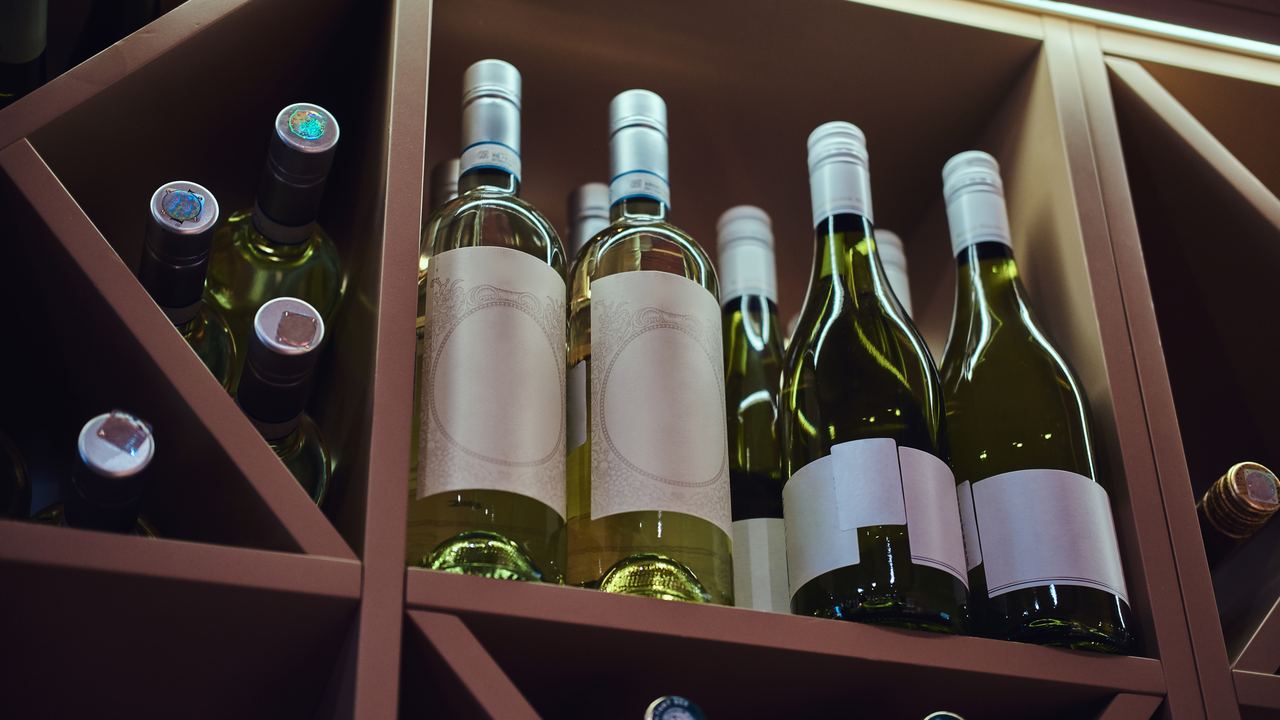
Wine bottles on diagonal shelves. The photo shows bottles, not a limit.
The sums below are ours, for a standard 75 cl bottle, and not a figure from any of the pages.
- EU, still wine: 4 litres is 5 bottles, with 0.25 litres left. A sixth bottle takes you to 4.5 litres.
- Great Britain: 18 litres is 24 bottles.
- Canada: 1.5 litres is 2 bottles. A single 1.5-litre magnum uses it all.
- Australia: 2.25 litres is 3 bottles, and every other drink counts against the same 3.
What should you do at a cellar door?
Do the sum before you pay, not at the airport. Count per person and per category, using the wording of the country you land in: sparkling wine counts toward the 18 litres in Great Britain, but toward the second block in the EU. In Australia a bottle of spirits from the same trip comes out of the same 2.25 litres. In Great Britain a partner's unused allowance does not transfer to you.
Keep the receipt. Australia asks for proof of purchase when you are over, and the EU page says the same when customs doubt that goods are for personal use. We did not read official guidance on posting wine home or on airline baggage rules, so this article does not cover either. How a tour listing says whether bottles or tastings are included is in our guide to reading a tour listing, and the split of a tour price is in what a wine tour costs.
Questions about bringing wine home
How many bottles is 4 litres of wine?
Five standard 75 cl bottles hold 3.75 litres, so 4 litres allows five bottles with a little room left. A sixth bottle brings the total to 4.5 litres. That is our arithmetic, not a figure on the EU page.
Do I have to declare wine to UK customs?
GOV.UK says you must declare goods when you go over an allowance, and goods that are banned or restricted. The allowance for wine in Great Britain is 18 litres. You can declare online from 5 days before you arrive or at the border.
What happens if I go over the allowance?
In Great Britain and Australia the pages say tax and duty apply to the whole category, not only the excess. Canada says duty, taxes and provincial levies apply to what exceeds your exemption, without saying more. Check the page of the country you land in.
Can I carry wine in hand luggage?
The only official page we read on this is the Australian one. It says aviation security rules may limit the liquids you bring as hand luggage and recommends packing duty-free alcohol in checked baggage where possible. Rules at the airport you leave from are a separate matter, and we did not read them.
How much wine can I bring into the United States?
The CBP page we read gives no figure. As summarised by the tool we used, the laws of the state where you first arrive govern the amount, and the page advises contacting that state's alcoholic beverage control board.
Where these facts come from
Allowances, ages, dates and the two quoted sentences were checked on the raw text of the pages below on 11 November 2026, except the US page, which we could only read through a summary. The bottle sums are ours.
- Your Europe: alcohol, tobacco and cash when you travel (last checked 21 September 2026 on the page)
- GOV.UK: Bringing goods into the UK for personal use, Arriving in Great Britain
- Canada Border Services Agency: What can you bring into Canada, personal exemptions (date modified 25 November 2025 on the page)
- Australian Border Force: Duty free (last updated 26 October 2026 on the page)
- US Customs and Border Protection: Prohibited and restricted items (read through a summary)
Not covered: Northern Ireland, New Zealand, Japan, Switzerland, shipping wine, and airline rules.
Data verified on . Official customs pages for the EU, Great Britain, Canada, Australia and the US. US page via summary. Next check: 2027-02-09. Editorial Policy
Wine Tours Editorial earns a commission when you book through links on this page. It does not change the price you pay. See our editorial policy.
Plan the wine trip before you pack the suitcase
Nine decisions in order, from choosing a tour to what to wear and pack.
